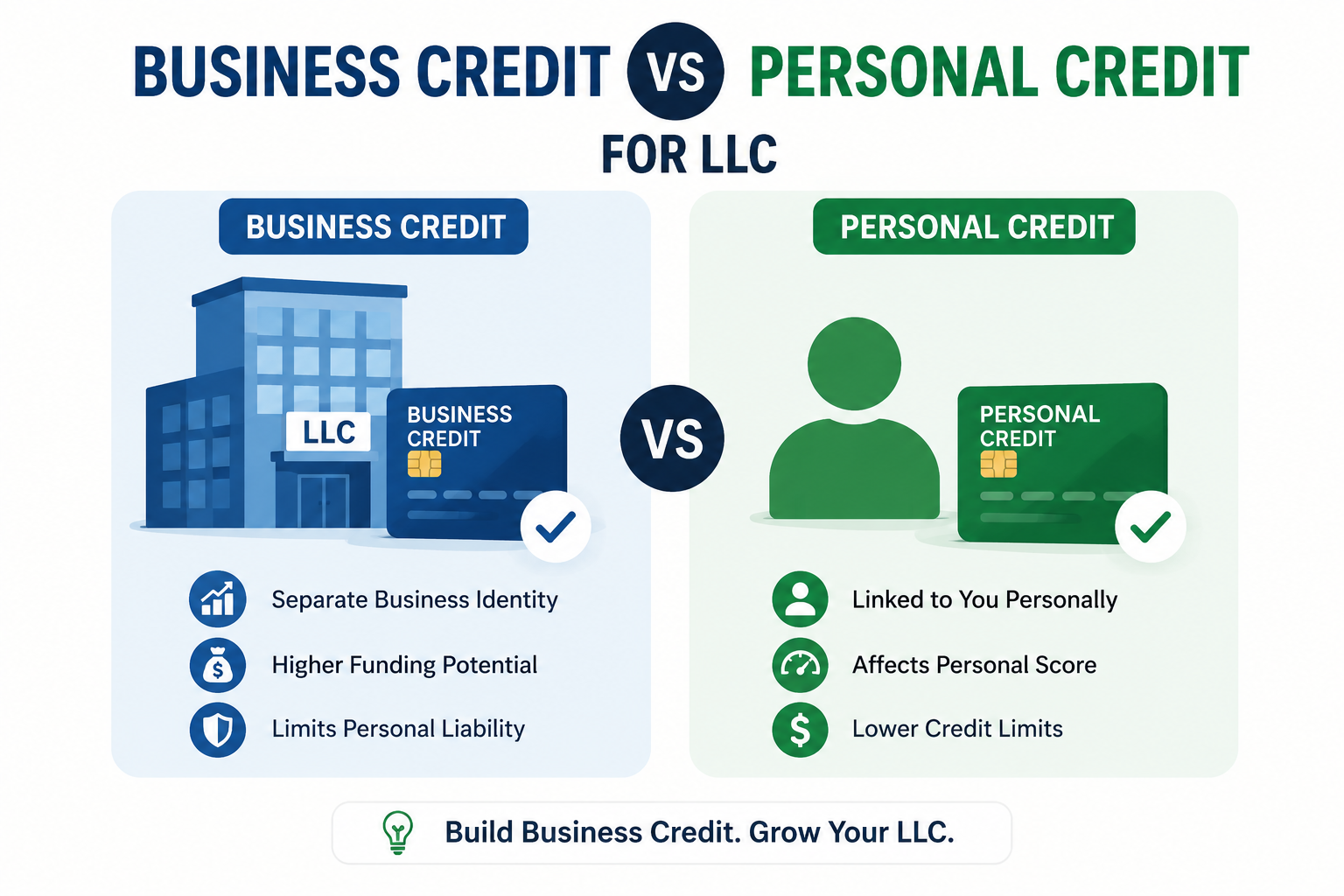
Business Credit vs Personal Credit for LLC: What Every Owner Needs to Know
Learn the key differences between business credit and personal credit for LLCs. Discover how each works, their benefits, impact on funding, and how to build strong business credit.
Forming an LLC feels like a milestone, but plenty of owners quietly keep running everything through their personal credit card the same way they did before incorporating. Understanding business credit vs personal credit for LLC ownership is not just an accounting technicality. It directly affects your legal protection, your ability to raise financing later, and how much personal risk you are carrying every single day your business operates.
This guide breaks down exactly how business credit and personal credit differ, why mixing them undermines the protection an LLC is supposed to provide, and a clear path to building strong business credit from scratch. Use the table of contents to jump to the section you need most, or read through for the complete picture.
Table of Contents
- What Business Credit Actually Is
- What Personal Credit Actually Is
- Key Differences Between Business and Personal Credit
- Why This Distinction Matters for Your LLC
- How Mixing Credit Can Pierce the Corporate Veil
- Step-by-Step: Building Business Credit for Your LLC
- Personal Guarantees and What They Really Mean
- Business Credit Scores Explained
- Common Mistakes New LLC Owners Make
- When Personal Credit Still Matters for LLC Owners
- Choosing the Right Financing as You Grow
- Frequently Asked Questions
What Business Credit Actually Is
Business credit is a credit profile tied entirely to your company through its Employer Identification Number, separate from your Social Security Number and personal financial history. Lenders, suppliers, and credit bureaus track this profile independently, building a financial reputation that belongs to the business itself rather than to you as an individual.
A strong business credit profile allows your LLC to secure financing, open vendor accounts, and negotiate better payment terms based entirely on the company’s own track record. This becomes especially valuable as the business grows, since it means future financing decisions rely on business performance rather than your personal financial history.
Business credit takes longer to build than personal credit, often requiring an established history of on-time payments, active vendor accounts, and consistent revenue before lenders view it as strong. The building business credit section further down walks through exactly how this process works from the very beginning.
What Personal Credit Actually Is
Personal credit is tied to your Social Security Number and reflects your individual financial behavior: credit card payments, loans, mortgages, and other personal obligations, regardless of whether you own a business.
Personal credit typically builds faster than business credit because personal credit bureaus have decades of standardized reporting practices, while business credit reporting remains more fragmented across different bureaus and reporting agencies.
Many new LLC owners rely entirely on personal credit in the early stages simply because it is the only credit history they have. This is common and often unavoidable at first, but the goal explored throughout this guide, especially in the why this matters section below, is transitioning away from that reliance as quickly as responsibly possible.
Key Differences Between Business and Personal Credit
Understanding business credit vs personal credit for LLC purposes comes down to a handful of core distinctions.
Legal Ownership of the Debt
Business credit debt legally belongs to the business entity. Personal credit debt belongs to you individually, regardless of whether the money was spent on business expenses.
Reporting Bureaus
Personal credit is reported through three major consumer bureaus. Business credit is reported through separate commercial bureaus that track companies rather than individuals, and these scores work differently than personal credit scores.
Impact on Personal Liability
This is the distinction covered in greatest depth in the piercing the corporate veil section below, because it is the single most important reason LLC owners should care about keeping these two forms of credit separate.
Access Requirements
Personal credit accounts typically require only your Social Security Number and personal financial history. Business credit accounts generally require an EIN, a registered business entity, and often a business bank account before approval.
Why This Distinction Matters for Your LLC
The entire point of forming an LLC is to create a legal separation between your personal assets and your business’s financial obligations. If your business credit and personal credit remain tangled together, that separation exists on paper but not in practice.
When a lender or vendor extends credit based on your personal guarantee rather than the business’s own standing, they are relying on your personal assets as collateral, whether or not that is explicitly stated. This quietly undermines the liability protection an LLC is designed to provide, since a business debt can now follow you personally if the company cannot pay.
Building genuine business credit, separate from your personal profile, is what allows your LLC’s protective structure to function as intended. The next section explains exactly how blurred lines between the two can create serious legal exposure.
How Mixing Credit Can Pierce the Corporate Veil
“Piercing the corporate veil” is the legal term for a court deciding that an LLC’s owner should be held personally liable for business debts, despite the LLC structure. Mixing business credit vs personal credit for LLC finances is one of the most common ways this happens.
Commingling Funds Is the Biggest Red Flag
Using a personal credit card for business expenses, or a business account for personal purchases, creates a paper trail showing the LLC was not truly operated as a separate entity. Courts look closely at this pattern when deciding liability disputes.
Consistency Matters More Than Perfection
An occasional mistake is less damaging than a consistent pattern of ignoring the separation between business and personal finances entirely. The goal is establishing clear, consistent habits, not achieving flawless record keeping from day one.
Proper Separation Strengthens Legal Protection
Keeping a dedicated business bank account, business credit accounts, and clean financial records, discussed further in the common mistakes section below, directly strengthens the legal wall between your personal assets and your business’s liabilities.
Step-by-Step: Building Business Credit for Your LLC
Building strong business credit takes time, but the process itself is straightforward when approached in the right order.
Step 1: Formalize the Business Properly
Register your LLC with your state, obtain an EIN from the IRS, and open a dedicated business bank account before pursuing any business credit at all. These foundational steps establish the business as a distinct legal and financial entity.
Step 2: Open Vendor Accounts That Report to Business Bureaus
Certain suppliers and vendors extend credit terms and report payment history directly to business credit bureaus. Paying these accounts on time consistently is one of the fastest ways to begin building a business credit history from nothing.
Step 3: Apply for a Business Credit Card
A business credit card tied to your EIN, rather than a personal card used for business expenses, begins building a credit history that belongs entirely to the company.
Step 4: Monitor Your Business Credit Reports
Just as you would check personal credit reports, regularly reviewing your business credit reports, explained further in the business credit scores section below, ensures errors are caught early and your progress is tracked accurately.
Step 5: Maintain Consistent, On-Time Payments
Payment history is the single largest factor in most business credit scoring models. Consistent, on-time payments across every business account build credit faster than any other single action.
Personal Guarantees and What They Really Mean
Many new LLCs cannot access business financing without a personal guarantee, and understanding exactly what this means is critical.
A Personal Guarantee Overrides LLC Protection for That Debt
When you sign a personal guarantee, you agree to be personally responsible for a specific business debt if the company cannot pay, regardless of the LLC structure. This is a deliberate exception carved out by the lender, not a flaw in your LLC.
Personal Guarantees Are Common Early On
Lenders often require personal guarantees for new businesses without an established credit history, since there is no independent business track record to evaluate yet, tying back to the building process covered in the building business credit section above.
The Goal Is Reducing Reliance on Guarantees Over Time
As your business credit profile strengthens, many lenders become willing to extend credit without a personal guarantee, which is one of the clearest signs your business credit vs personal credit for LLC separation is working as intended.
Business Credit Scores Explained
Business credit scores work differently than the personal credit scores most people are familiar with, and understanding the differences prevents confusion.
Scoring Ranges Differ From Personal Credit
Business credit scores often use different numeric ranges and scoring models than personal credit scores, meaning a “good” business credit score is not evaluated the same way as a good personal score.
Business Scores Can Be Viewed by Anyone
Unlike personal credit reports, which require your permission to access, business credit reports can often be purchased by any interested party, including potential partners, landlords, or competitors, making it especially important to keep the profile accurate and strong.
Multiple Bureaus Track Different Data
Several commercial credit bureaus operate independently, each with its own scoring model and data sources, so a complete picture of your business credit vs personal credit for LLC standing often requires checking more than one bureau.
Common Mistakes New LLC Owners Make
These recurring mistakes undermine both liability protection and credit-building progress for new LLC owners.
1. Using Personal Cards for Business Purchases
Even small, occasional purchases on a personal card for business expenses contribute to the commingling problem described in the piercing the corporate veil section above.
2. Never Opening a Business Bank Account
Running business income and expenses through a personal checking account eliminates the clear separation an LLC is supposed to provide, regardless of how good your intentions are.
3. Ignoring Business Credit Reports Entirely
Many owners check their personal credit regularly but never look at their business credit reports, missing errors or fraud that could otherwise be caught early.
4. Waiting Too Long to Start Building Business Credit
The earlier you begin building business credit following the steps in the building business credit section, the sooner your LLC can access financing without relying on personal guarantees or personal credit checks.
When Personal Credit Still Matters for LLC Owners
Even with a strong business credit profile, personal credit does not become irrelevant for LLC owners entirely.
Lenders Often Check Both During Early Growth
Until a business credit profile matures, many lenders still review the owner’s personal credit as part of the approval process, particularly for larger financing requests.
Personal Credit Affects Personal Financial Goals
Buying a home, financing a personal vehicle, or applying for personal loans still relies on your personal credit, regardless of how well your business credit performs, which is why maintaining healthy personal credit alongside business credit remains worthwhile.
A Strong Personal Foundation Supports Business Growth
Particularly in the early stages discussed in the personal guarantees section above, a solid personal credit history can make it easier to access initial business financing while your business credit is still developing.
Choosing the Right Financing as You Grow
As your LLC matures, you will face decisions about which type of financing best fits a given need, and understanding business credit vs personal credit for LLC options helps guide that decision.
Use Business Credit for Ongoing Operational Expenses
Inventory, supplies, and recurring vendor payments are best handled through business credit accounts that continue strengthening your company’s independent credit profile.
Reserve Personal Credit for True Emergencies Only
If business credit options are exhausted and personal credit becomes necessary, treat it as a temporary bridge rather than a habitual financing method, and prioritize paying it down quickly to limit personal exposure.
Reassess Your Financing Strategy Annually
As your business credit profile strengthens over time, following the steps outlined in the building business credit section above, revisit your financing options each year to take full advantage of improved terms and reduced reliance on personal guarantees.
Bringing It All Together
Business credit vs personal credit for LLC owners is not simply a matter of preference. It directly affects your legal protection, your long-term financing options, and how much personal risk sits behind every business decision you make. Start by formalizing your LLC properly, open dedicated business accounts, and begin building business credit deliberately using the steps outlined above, rather than defaulting to personal credit out of convenience.
Over time, this separation becomes one of the most valuable assets your business owns, quietly reducing your personal risk while opening doors to financing your business could not access otherwise.
Frequently Asked Questions
Does an LLC automatically protect my personal credit?
No. Forming an LLC provides legal separation, but that protection can be undermined if you commingle funds or rely heavily on personal credit, as explained in the piercing the corporate veil section above.
How long does it take to build business credit for a new LLC?
Building a solid business credit profile typically takes consistent, on-time activity over many months, following the process described in the building business credit section, rather than happening instantly.
Will I always need a personal guarantee for business financing?
Not necessarily. As your business credit profile strengthens, discussed in the personal guarantees section, many lenders become willing to extend credit without requiring one.
Can checking my business credit report hurt my score?
Reviewing your own business credit reports, covered in the business credit scores section, generally does not negatively affect your score and is an important habit for catching errors early.