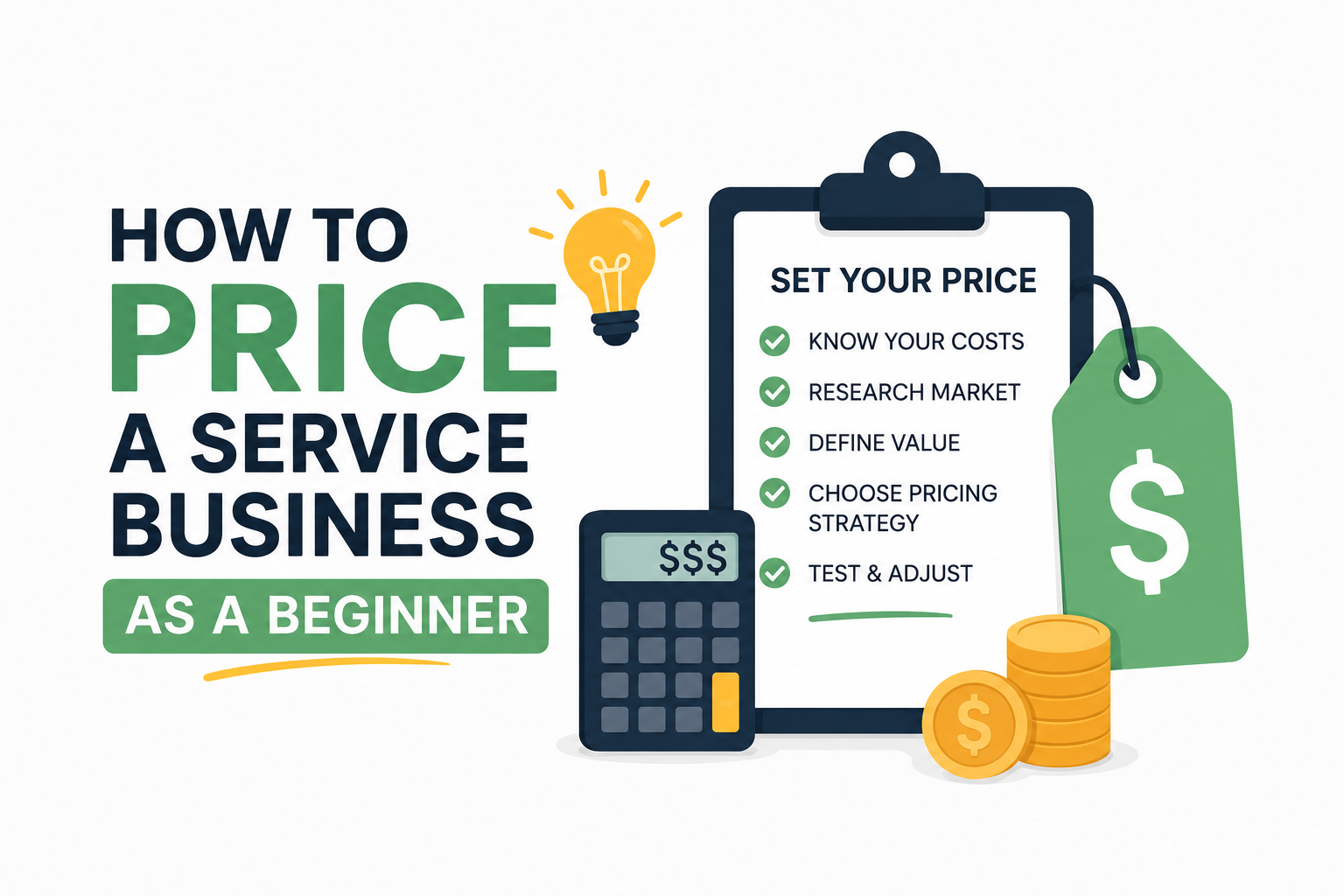
How To Price A Service Business As A Beginner (With No Experience Yet)
There is a very specific kind of fear that hits before sending your very first quote: no portfolio, no testimonials, no track record, and absolutely no idea whether the number you are about to type is reasonable or laughable. Learning how to price a service business as a beginner is a genuinely different challenge from pricing an established business, because you are not just setting a number, you are setting it without any of the proof points experienced providers lean on.
This guide is written specifically for that starting point: no clients yet, no case studies, no confidence built from past wins. It covers how to price your very first few projects, how to talk about price without your voice shaking, when and how to raise your rates as you gain experience, and the specific mistakes that keep beginners stuck charging beginner prices years after they stopped being beginners. Use the table of contents below to jump to what you need most, or read through for the complete picture.
Table of Contents
- Why Pricing Feels Different With Zero Experience
- Setting Your First Price Without a Track Record
- Researching Rates Without Just Copying a Number
- Should Your Very First Project Ever Be Free?
- Pricing During Your Portfolio-Building Phase
- How to Actually Say Your Price Out Loud
- Handling Pushback When You Have No Reviews Yet
- Knowing When You’re Ready to Raise Your Rates
- Tracking the Numbers That Matter Early On
- Common Beginner Pricing Mistakes
- Frequently Asked Questions
Why Pricing Feels Different With Zero Experience
Every pricing guide eventually tells you to price based on value and experience, which is genuinely good advice once you have either of those things to point to. As a true beginner, you have neither yet, which means the usual pricing frameworks can feel almost unusable at the exact moment you need guidance the most.
Read Also 👉 Side Hustle Ideas With Low Startup Cost: Best Ways to Start Making Extra Income
What makes this stage different is not that the math changes, but that your confidence has nothing to stand on. An experienced provider can say a number and mean it, because they have delivered that outcome before. A beginner is essentially asking someone to trust a promise rather than a proof, which is precisely why beginner pricing needs its own approach rather than simply a smaller version of expert pricing advice.
Setting Your First Price Without a Track Record
Your very first price does not need to be perfect. It needs to be defensible, sustainable for you, and honest about where you currently are.
Start From Your Actual Costs, Not a Feeling
Even as a beginner, calculate what your time is genuinely worth based on your living expenses and the hours you can realistically dedicate, rather than picking a number that simply feels comfortable to say out loud. A number grounded in real math is far easier to hold firm on than one based purely on gut feeling.
Accept That Your First Price Is a Starting Point, Not a Life Sentence
Many beginners freeze because they treat their first quoted price as a permanent decision. In reality, it is simply the number that gets you your first project, and it is expected to change as you gain the experience discussed further in the knowing when you’re ready to raise your rates section below.
Avoid Picking a Number Just to Avoid Rejection
Setting a price low enough that you are certain no one will say no is a common beginner instinct, but it usually backfires, since it often attracts clients who are the hardest to work with and least likely to value your work appropriately.
Researching Rates Without Just Copying a Number
Looking at what others charge is a reasonable starting point, but copying a number directly, without understanding why it exists, sets a shaky foundation.
Look for a Range, Not a Single Number
Research a general range across several providers in your space rather than fixating on one specific competitor’s price, since a single data point tells you very little about what is actually sustainable or appropriate for your situation.
Understand That Established Providers Are Pricing Their Experience, Not Just the Task
A provider with five years of results behind them is not charging purely for the hours a task takes. They are charging for the reduced risk and proven outcome their experience represents, which is a meaningfully different value proposition than what you are currently offering as a beginner.
Use Research to Set a Floor, Not a Ceiling
Rather than assuming you must price below every competitor simply because you are newer, use market research to understand the lowest reasonable price for the work itself, then price at or slightly below that floor rather than dramatically undercutting the entire market.
Should Your Very First Project Ever Be Free?
This is one of the most debated questions among beginners, and the honest answer depends heavily on what you are actually trying to gain.
When Free Work Can Make Sense
A small, clearly bounded free project in exchange for a genuine testimonial and permission to use the result in your portfolio can make sense if you have absolutely nothing to show potential clients yet, provided it is treated as a deliberate, limited exception rather than your ongoing business model.
Why Free Work Becomes a Trap
The danger is that free work rarely stays limited to one project. Clients who received free value once often expect discounted or free work again, and other prospective clients who hear about it may expect the same treatment, making it considerably harder to transition into paid work later.
A Better Alternative: Heavily Discounted, Never Free
Charging a small but real amount, even significantly below your eventual target rate, tends to produce more serious clients and more respectful working relationships than working entirely for free, while still helping you build the portfolio discussed in the portfolio-building phase pricing section below.
Pricing During Your Portfolio-Building Phase
The period between your very first project and having enough proof to price confidently is a distinct phase that deserves its own strategy.
Set an Explicit Discount, Not an Accidental One
Rather than simply charging whatever feels safe project by project, decide deliberately that you are offering a temporary portfolio-building discount, with a clear internal sense of how many projects or how much time this phase will last before prices increase.
Prioritize Projects That Genuinely Showcase Your Skill
During this phase, favor projects that will look strong in a portfolio and generate genuine testimonials over projects that pay slightly more but offer little you can show future clients.
Communicate the Discount as Intentional
Framing your reduced rate as an intentional, temporary offer, rather than apologizing for your inexperience, maintains far more credibility with clients than admitting uncertainty about your own pricing.
How to Actually Say Your Price Out Loud
For many beginners, the math is not actually the hardest part. Saying the number without flinching is.
Practice the Exact Sentence in Advance
Write out and practice the specific sentence you will use to state your price before you are ever in a real conversation, so the words come out smoothly rather than being improvised under nervous pressure.
State the Price Once, Clearly, Without Immediately Justifying It
Resist the urge to immediately follow your price with a nervous explanation or apology. Stating the number plainly, then pausing, signals far more confidence than over-explaining ever will.
Remember That Confidence Is a Skill, Not a Trait You Either Have or Don’t
Like any other business skill, comfortably stating a price improves with repetition. Your tenth quote will feel considerably easier to deliver than your first, regardless of how nervous that first one feels right now.
Handling Pushback When You Have No Reviews Yet
Without testimonials or a track record, price pushback can feel especially difficult to handle as a beginner.
Acknowledge the Concern Without Undermining Yourself
If a prospective client questions your price given your lack of experience, acknowledge the concern honestly rather than becoming defensive, while still holding firm on the number you have calculated as fair and sustainable.
Offer a Smaller Scope Rather Than a Lower Price
If a client’s budget genuinely cannot meet your price, consider reducing the scope of what you deliver rather than reducing your rate for the same amount of work, protecting the pricing foundation discussed in the setting your first price section above.
Recognize When a Client Is Simply Not the Right Fit Yet
Some prospective clients will only ever want the lowest possible price regardless of your experience level. Losing this type of client, even as a beginner with few options, is often a better outcome than working with someone who fundamentally undervalues your time from the very first conversation.
Knowing When You’re Ready to Raise Your Rates
One of the most common beginner mistakes is staying at introductory pricing long after it has stopped making sense.
Watch Your Win Rate as a Signal
If you are winning nearly every single proposal or inquiry you send, this is often a sign your price is too low relative to your current skill and demand, not simply a sign you are doing everything right.
Let a Growing Portfolio Justify an Increase
Once you have completed several successful projects and gathered genuine testimonials, described in the portfolio-building phase pricing section above, you now have the proof points that were missing when you first started, which justifies moving away from beginner pricing.
Raise Rates for New Clients Before Existing Ones
A practical, low-friction way to test a higher rate is applying it only to new inquiries first, rather than immediately renegotiating with clients who joined you at your original beginner price.
Tracking the Numbers That Matter Early On
Even as a beginner, tracking a few simple numbers prevents pricing decisions from being based purely on feeling.
Track How Long Projects Actually Take
Recording actual time spent on early projects, compared to what you originally estimated, reveals whether your current pricing genuinely covers your real effort or quietly underpays you once true time investment is accounted for.
Track Your Win Rate by Price Point
Keeping a simple record of how many quotes at a given price are accepted versus declined gives you real data to reference when deciding whether you are ready for the rate increase discussed above, rather than guessing based on a handful of recent conversations.
Track Repeat Client Requests
Clients who return for additional work or refer you to others are a strong signal that your current pricing, relative to the value you delivered, is working well and may even be underpriced.
Common Beginner Pricing Mistakes
Several specific mistakes affect beginners in ways that rarely apply to more established providers.
1. Pricing to Avoid Rejection Rather Than to Sustain the Work
Setting a price so low that saying no feels impossible for any client, rather than the sustainable number described in the setting your first price section above, often leads to burnout before real experience is even built.
2. Staying at Beginner Rates Long After Gaining Real Experience
Continuing to charge your very first rate well after building a solid portfolio and track record, rather than following the signals described in the knowing when you’re ready to raise your rates section, leaves significant money on the table unnecessarily.
3. Apologizing for Inexperience Instead of Framing It Honestly
Over-explaining your lack of experience during a pricing conversation, rather than calmly acknowledging it as described in the handling pushback section above, undermines confidence that could otherwise be maintained.
4. Doing Unlimited Free Work to “Build Experience”
Allowing free work to expand indefinitely, rather than the deliberate, limited approach described in the should your first project ever be free section, delays the transition into sustainable paid work far longer than necessary.
Bringing It All Together
Learning how to price a service business as a beginner is less about finding a perfect formula and more about accepting that your first price is a reasonable starting point, not a permanent identity. Ground your number in real costs rather than fear, treat any free or discounted work as a deliberate, limited phase rather than an open-ended habit, practice stating your price with confidence, and track the simple numbers that tell you when it’s genuinely time to raise your rates. Revisit the setting your first price section whenever self-doubt creeps back in, since the math, not your nerves, should be what anchors your price.
Frequently Asked Questions
Is it okay to charge less as a complete beginner with no portfolio?
Yes, temporarily. As explained in the pricing during your portfolio-building phase section above, a deliberate, limited discount is reasonable as long as it is treated as a phase rather than a permanent rate.
Should I ever work completely for free to get my first client?
Generally, no. As discussed in the should your first project ever be free section, a small but real payment tends to produce better client relationships than working entirely for free.
How do I know when I’m ready to stop charging beginner rates?
Watch your win rate and portfolio strength, as explained in the knowing when you’re ready to raise your rates section above. Winning nearly every quote is often a sign you are already underpriced.
What do I say if a client questions my price because I’m new?
Acknowledge the concern honestly without becoming defensive or apologetic, as covered in the handling pushback section above, and consider adjusting scope rather than your rate.