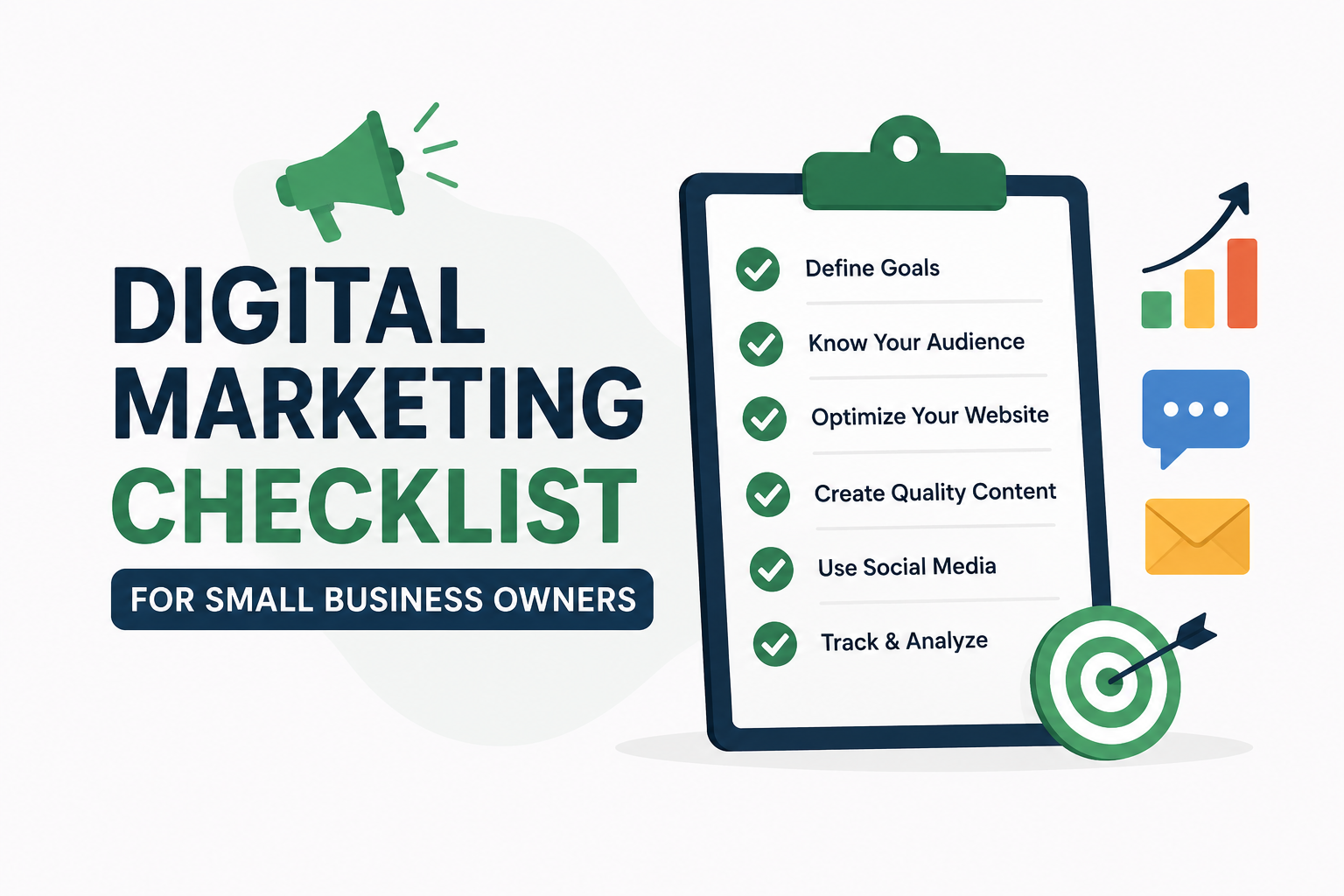
Digital Marketing Checklist For Small Business Owners: The Complete Guide
Most small business owners did not start their business because they wanted to become marketers, yet digital marketing has quietly become one of the most important skills standing between a business that grows steadily and one that struggles to be found at all. A proper digital marketing checklist for small business owners removes the guesswork, replacing scattered, occasional posting with a clear, repeatable system covering everything from your website to local search to email and paid ads.
This guide walks through every major area a small business needs to cover, organized as a genuine checklist you can work through in order, along with realistic guidance on what actually matters most when time and budget are limited. Use the table of contents below to jump to the section most relevant to you, or work through the entire guide in sequence to build a complete marketing foundation.
Table of Contents
- Why a Checklist Approach Works Better Than Random Effort
- Website Fundamentals Checklist
- Local SEO Checklist
- Social Media Checklist
- Content Marketing Checklist
- Email Marketing Checklist
- Paid Advertising Checklist
- Online Reviews and Reputation Checklist
- Analytics and Tracking Checklist
- Monthly Marketing Review Routine
- How to Prioritize When You Have Limited Time and Budget
- Common Mistakes Small Business Owners Make
- Frequently Asked Questions
Why a Checklist Approach Works Better Than Random Effort
Digital marketing advice online is often presented as an endless, overwhelming list of tactics, leaving small business owners paralyzed by choice rather than taking consistent action. A checklist approach solves this by breaking marketing down into discrete, completable tasks rather than one enormous, undefined project.
This structure matters especially for small business owners juggling marketing alongside actually running their business, since it allows you to make genuine progress in short, defined sessions rather than needing large uninterrupted blocks of time to “figure out marketing” all at once. Each section below is designed to be worked through independently, checked off, and revisited periodically as your business grows.
Website Fundamentals Checklist
Your website is the foundation every other marketing channel eventually points back to, making it the logical starting point for this checklist.
Core Website Checklist Items
- Clear business name, logo, and tagline visible immediately on the homepage
- Fast loading speed on both desktop and mobile devices
- Mobile-friendly design that displays correctly on phones and tablets
- A visible, working contact method, including phone number, email, and physical address if applicable
- Clear calls to action on every page, telling visitors exactly what to do next
- An About page that explains who you are and why customers should trust you
- Secure HTTPS connection, shown by a padlock icon in the browser address bar
Why This Section Comes First
Every other channel covered in this guide, from social media to paid advertising, ultimately drives traffic back to your website. Fixing fundamental issues here first ensures that effort spent on the sections below is not wasted sending visitors to a page that fails to convert them.
Local SEO Checklist
For businesses serving a specific geographic area, local search visibility often matters more than general search engine rankings.
Core Local SEO Checklist Items
- Claimed and fully completed Google Business Profile listing
- Consistent business name, address, and phone number across every online listing and directory
- Business category and services accurately selected within your Google Business Profile
- Photos of your location, products, or team uploaded to your profile
- Regular posts or updates published through your Google Business Profile
- Location-specific keywords included naturally in your website content
Why Consistency Matters So Much Here
Search engines cross-reference your business information across multiple directories and listings. Inconsistent addresses or phone numbers between your website, Google listing, and other directories can quietly undermine your local search rankings, even if each individual listing looks fine on its own.
Read Also 👉 How To Market A Business On WhatsApp
Social Media Checklist
Social media should be treated as a focused tool rather than an obligation to be present everywhere simultaneously.
Core Social Media Checklist Items
- Business profiles claimed on the one or two platforms where your actual customers spend time
- Consistent profile picture, bio, and contact information across every active platform
- A simple, sustainable posting schedule, even if that means only two or three posts per week
- A content mix that includes more than pure promotion, such as behind-the-scenes content or customer stories
- Prompt responses to comments and direct messages
Choosing Platforms Deliberately
Rather than maintaining a weak presence across every available platform, choosing one or two platforms where your specific audience is genuinely active and committing to consistent posting there produces far better results than scattered effort everywhere.
Content Marketing Checklist
Content marketing supports nearly every other channel in this checklist, from search visibility to social media material.
Core Content Marketing Checklist Items
- A running list of common customer questions to answer through blog posts or videos
- A simple content calendar planning topics at least a month in advance
- Content genuinely useful to your audience, not purely promotional
- Blog posts or videos structured for easy scanning, using clear headings and short paragraphs
- Existing content repurposed across multiple channels rather than created from scratch every time
Repurposing Saves Significant Time
A single well-researched blog post can be broken into several social media posts, an email newsletter section, and short video content, meaningfully reducing the total time investment required compared to creating entirely new content for every channel separately.
Email Marketing Checklist
Email remains one of the highest-return marketing channels available to small businesses, since you own your email list directly rather than depending on a social platform’s algorithm.
Core Email Marketing Checklist Items
- An email collection method visible on your website, such as a signup form or newsletter offer
- A welcome email automatically sent to new subscribers
- A consistent sending schedule, even if only monthly
- Segmented lists separating customers from general subscribers where relevant
- Clear subject lines that accurately reflect email content
Why Email Deserves More Attention Than It Often Gets
Unlike social media followers, your email list cannot disappear due to a platform policy change or algorithm shift. Building this list deliberately, even slowly, creates a genuinely owned marketing asset that becomes increasingly valuable over time.
Paid Advertising Checklist
Paid advertising can accelerate results significantly, but only once the fundamentals covered in the sections above are genuinely solid.
Core Paid Advertising Checklist Items
- A clearly defined target audience before launching any campaign
- A specific, measurable goal for each campaign, such as leads, sales, or website visits
- A dedicated landing page matching the ad’s specific offer, rather than sending traffic to a generic homepage
- A modest starting budget to test performance before committing significant spend
- Conversion tracking set up before the campaign launches, discussed further in the analytics and tracking checklist section below
Why This Section Comes After the Others
Paid advertising sends traffic to whatever website and offer you already have in place. If the fundamentals covered earlier in this checklist are not solid, paid ads simply accelerate the rate at which visitors leave without converting, wasting budget rather than generating results.
Online Reviews and Reputation Checklist
Customer reviews increasingly influence buying decisions as much as, or more than, a business’s own marketing claims.
Core Reviews Checklist Items
- A simple, consistent process for asking satisfied customers to leave a review
- Prompt, professional responses to every review, both positive and negative
- Reviews monitored across every platform where your business appears, not just one
- Negative feedback treated as an opportunity to demonstrate good customer service publicly
Why Responding to Every Review Matters
Prospective customers frequently read how a business responds to negative reviews as closely as they read the reviews themselves. A calm, professional response to criticism often builds more trust than a flawless five-star record with no responses at all.
Analytics and Tracking Checklist
Without tracking, it becomes impossible to know which parts of this checklist are actually working and which are wasting time and budget.
Core Analytics Checklist Items
- Website analytics installed and reviewed regularly, not just set up and forgotten
- Clear goals defined for what counts as a meaningful conversion on your website
- Traffic sources reviewed to understand which channels are genuinely driving visitors
- Social media and email performance reviewed alongside website analytics, not in isolation
Data Should Drive Decisions, Not Just Sit in a Dashboard
Collecting analytics data without regularly reviewing it defeats the purpose entirely. This is why the monthly marketing review routine section below treats analytics as an active, recurring habit rather than a one-time setup task.
Monthly Marketing Review Routine
A checklist only creates lasting value if it is revisited consistently rather than completed once and forgotten.
What to Review Each Month
- Website traffic and conversion trends compared to the previous month
- Which social media posts and content performed best, and why
- Email open and click rates, along with list growth
- New reviews received and how they were responded to
- Any paid advertising performance, adjusting budget toward what is genuinely working
Keep the Review Session Short and Scheduled
A focused thirty to sixty minute monthly review, scheduled on your calendar like any other important business task, is far more sustainable than an occasional, unstructured attempt to “check on marketing” whenever time happens to allow.
How to Prioritize When You Have Limited Time and Budget
Very few small business owners can realistically execute every item on this checklist simultaneously, making prioritization essential.
Fix Your Website Foundation First, Always
Regardless of which other channels you eventually invest in, the website fundamentals checklist should always come first, since every other channel ultimately depends on it converting visitors effectively.
Choose One or Two Channels to Do Well Rather Than Many Done Poorly
Attempting the entire checklist superficially at once typically produces worse results than executing local SEO and one social media platform genuinely well, then expanding into additional channels as time and budget allow.
Let Your Customer’s Behavior Guide Channel Selection
Prioritize whichever channels your actual customers are most likely to use, rather than whichever channel currently feels trendiest, ensuring your limited time is spent where it can genuinely reach your audience.
Common Mistakes Small Business Owners Make
Several recurring mistakes undermine otherwise reasonable marketing efforts.
1. Skipping Website Fundamentals to Chase Social Media Trends
Investing heavily in social media content while neglecting basic issues from the website fundamentals checklist above means driving traffic to a page that fails to convert it.
2. Being Present on Too Many Platforms at Once
Spreading limited time across every available social platform, rather than the focused approach described in the social media checklist section, results in weak, inconsistent presence everywhere instead of strong presence somewhere.
3. Never Reviewing Analytics After Setting Them Up
Installing tracking tools once and never revisiting them, rather than following the monthly marketing review routine above, means marketing decisions continue to be made on guesswork rather than real data.
4. Launching Paid Ads Before Fixing Fundamentals
Spending on advertising before addressing basic website and offer issues, rather than following the sequence suggested throughout this guide, wastes budget accelerating traffic to a page that was never going to convert well in the first place.
Bringing It All Together
A genuine digital marketing checklist for small business owners works through a deliberate sequence: solid website fundamentals first, strong local visibility next, focused social media and content efforts, an owned email list, reviews actively managed, and paid advertising layered on only once these foundations are solid. Revisit this checklist not as a one-time project but as a living system, reviewed monthly using the routine described above, and prioritized according to your specific time, budget, and where your actual customers spend their attention.
Frequently Asked Questions
Where should a small business owner start if they have no marketing in place at all?
Begin with the website fundamentals checklist above, since every other marketing channel ultimately depends on your website converting visitors effectively.
How many social media platforms should a small business realistically manage?
Generally one or two, chosen deliberately based on where your actual customers spend time, as explained in the social media checklist section above.
Is email marketing still worth it for small businesses in 2026?
Yes. As discussed in the email marketing checklist section, email remains one of the few channels a business fully owns, rather than depending on a social platform’s changing algorithm.
Should a small business invest in paid ads before doing anything else?
No. As explained in the paid advertising checklist section above, paid ads work best once website and offer fundamentals are already solid, rather than as a first step.